Genesis 46: The One True God

A journey through Scripture and praying it chapter by chapter.
The reading today was rich and full of insight—it wasn’t hard to quickly identify a Core 4. So what is a Core 4? Simply put, it’s four key takeaways from a chapter of Scripture.
I use this Core 4 to help frame my prayer time. It gives me starting points to talk with the Lord, while also creating space to pause, reflect, and listen for what He wants to say.
It’s a simple way to stay focused, go deeper, and turn reading into a real conversation with God.

1. Hā’êl - Only true God
In verse 1, Jacob (Israel) offers sacrifices to Elohim—a general name for God. But in verse 3, God speaks and uses Jacob’s name twice, almost as if to say, pay attention to this.
“I am God…” — Hā’êl, the Mighty One. Powerful. Strong. The ONLY God.
What’s interesting is that this specific name is used only twice in Genesis, both times when God speaks directly to Jacob (Genesis 31:13 and here in 46:3).
God is reminding Jacob of something foundational.
Yes, you’ve encountered many gods, rulers, and people—but I am not one among many.
In a world surrounded by many “gods,” I am the ONLY true God.
2. Do not be afraid.
This isn’t a one-time statement—it’s a pattern we see throughout the lives of the patriarchs. God says it to Abraham. He says it to Isaac. And now, He says it to Jacob (Israel).
Just because you are a leader doesn’t mean you won’t feel afraid.
We see in the previous chapters that Jacob certainly did fear. But God, in His kindness, speaks directly into that fear: “Do not be afraid.”
God doesn’t call leaders because they are fearless—He calls them and then gives them the courage they need.
He guides those He raises. And part of that guidance is this steady reminder:
You don’t have to be afraid.
3. I will go down.
“I Myself will go down with you to Egypt.”
There’s something powerful in that phrase “go down.” It literally means to descend to a lower place.
We’ve heard Jacob use this language before. In Genesis 37:35, he says he will “go down” to Sheol in his grief, believing he has lost his son. For Jacob, going down was tied to sorrow, loss, and his deepest fear.
Now God uses that same language—but He reframes it.
It’s as if God is saying:
It may feel like a descent into the unknown, but I am going with you.
There’s also an interesting contrast. When God spoke to Isaac, He told him not to go to Egypt. But here with Jacob, God says, “Go—and I will go with you.”
The destination may change, but the promise remains the same:
God’s presence.

4. Rest in God’s plan.
Remember a few chapters back when Leah, Rachel, Bilhah, and Zilpah were all caught in that painful struggle over children? Especially between Leah and Rachel, there was constant tension, longing, and comparison.
But now, in this chapter, we step back and see the bigger picture.
We see the names—the descendants of Israel—and what becomes clear is this:
God was faithful to all of them.
Every one of them was blessed with children.
And yet, there are unique layers within that faithfulness. Leah, the unloved one, not only had more children, but she also carried the line of Christ. God saw her. God loved her.
Rachel, though she struggled for so long, was given Joseph—the one God would use to preserve the entire family and ultimately protect the line of Judah.
So both women, in different ways, were deeply blessed.
And that’s the tension we live in, too.
In the moment, it can feel like chaos—like we’re unseen, unheard, or unloved. But when we step back, we begin to see the faithfulness of God woven through every detail.
If we could fast-forward and see what God is doing, we probably wouldn’t have room for worry or fear.
But we don’t live in the future, we live in the middle of the story.
Rest in His plan. It’s always best!
PSALM praying
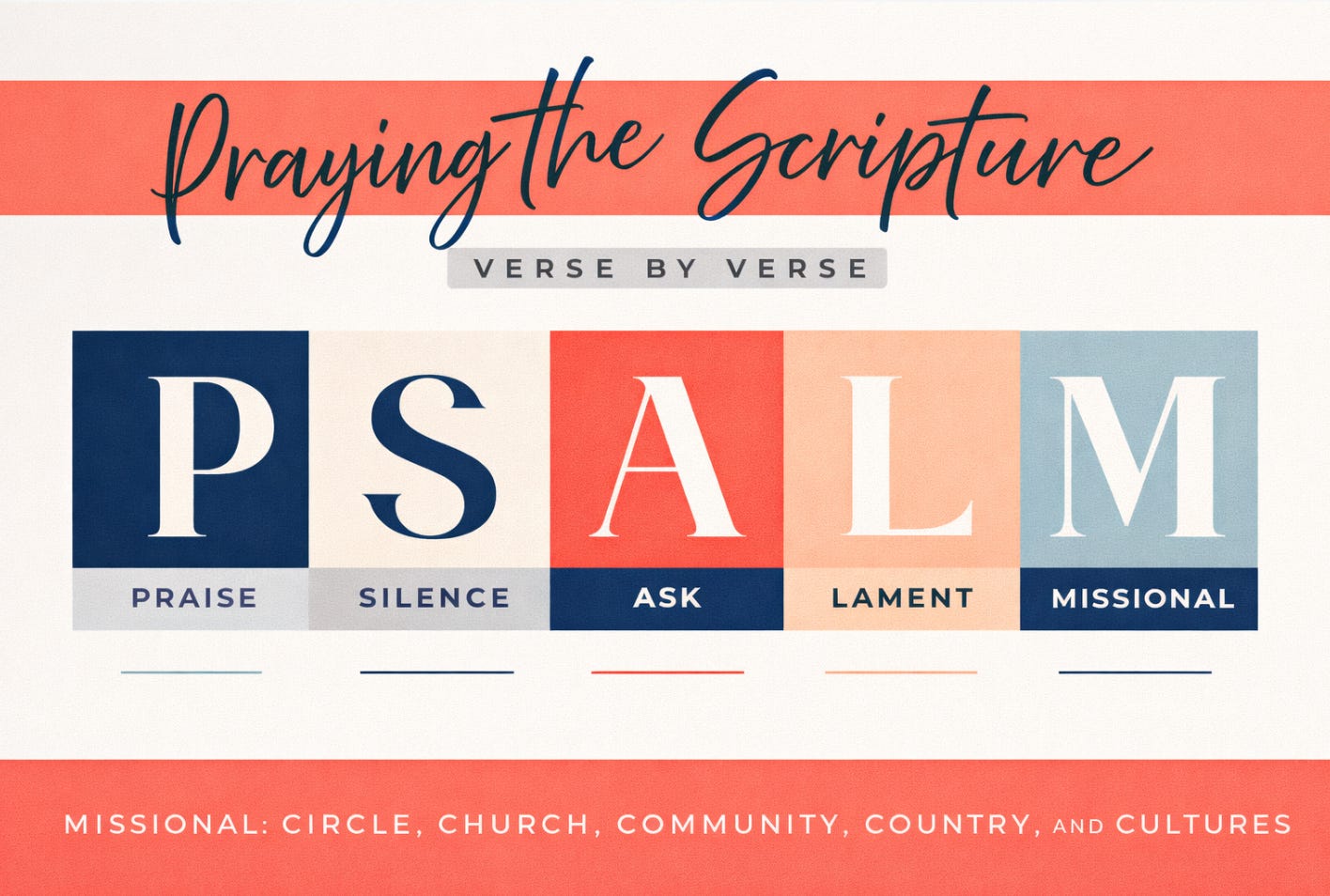
Using the P.S.A.L.M. acronym as a pattern can create a deep, meaningful way to pray. When we pray God’s Word, it carries weight—because His Word is living and active (Hebrews 4:12).
As we pray Scripture, we’re not just speaking our own thoughts—we’re aligning our hearts with His. His Word takes root, dwells within us, and shapes everything about us, including our prayer life.
There’s no perfect formula or “right” way to pray. This is simply a tool—a way to help us grow in depth and then magnify Him as we see His marvelous, mighty deeds come alive before our very eyes.
Praise
Using Genesis 46, praise Him for who He is and what He has revealed to you through His word.
I am praising Him that He is the One. True. God. He is the Mighty One, powerful and strong.
He is Courage, Strength, and Might. I don’t have to fear because He holds all things together.
I am praising Him today because He is with us. He will never leave us or forsake us!
God’s plan is perfect. He IS rest, and we can rest in Him and His plan for us.
Silence - be still
Today was full of joy and awe as I sat in the mind space of Him being the mighty, powerful, and most awesome God.
Ask
Asking will look different for everyone. For me, the Core 4 is something I am praying on behalf of many things and people, as I use this time to intercede for what God brings to mind.
Lament - confess
As I shared above, the things that God brings to light in my life lead me in confession. What are we lamenting and bringing to the Lord in confession?
Mission- pray for church. circle. community. country. cultures/great commission.
This is where I use the Core 4 to pray over my church, my circle, my community, my country, and the world. I use the 5 C’s as a guide to stay intentional about who I’m lifting up in prayer.
One of the most powerful parts of missional prayer is what comes next—encouragement.
I set aside the final portion of my prayer time to reach out to 5–10 people God has placed on my heart. A simple message, a word of encouragement, or a verse that I’ve specifically been praying over them.
This is where it all comes full circle—where prayer is woven into action, and what begins in the quiet flows outward into the lives of others.


Comments
Post a Comment